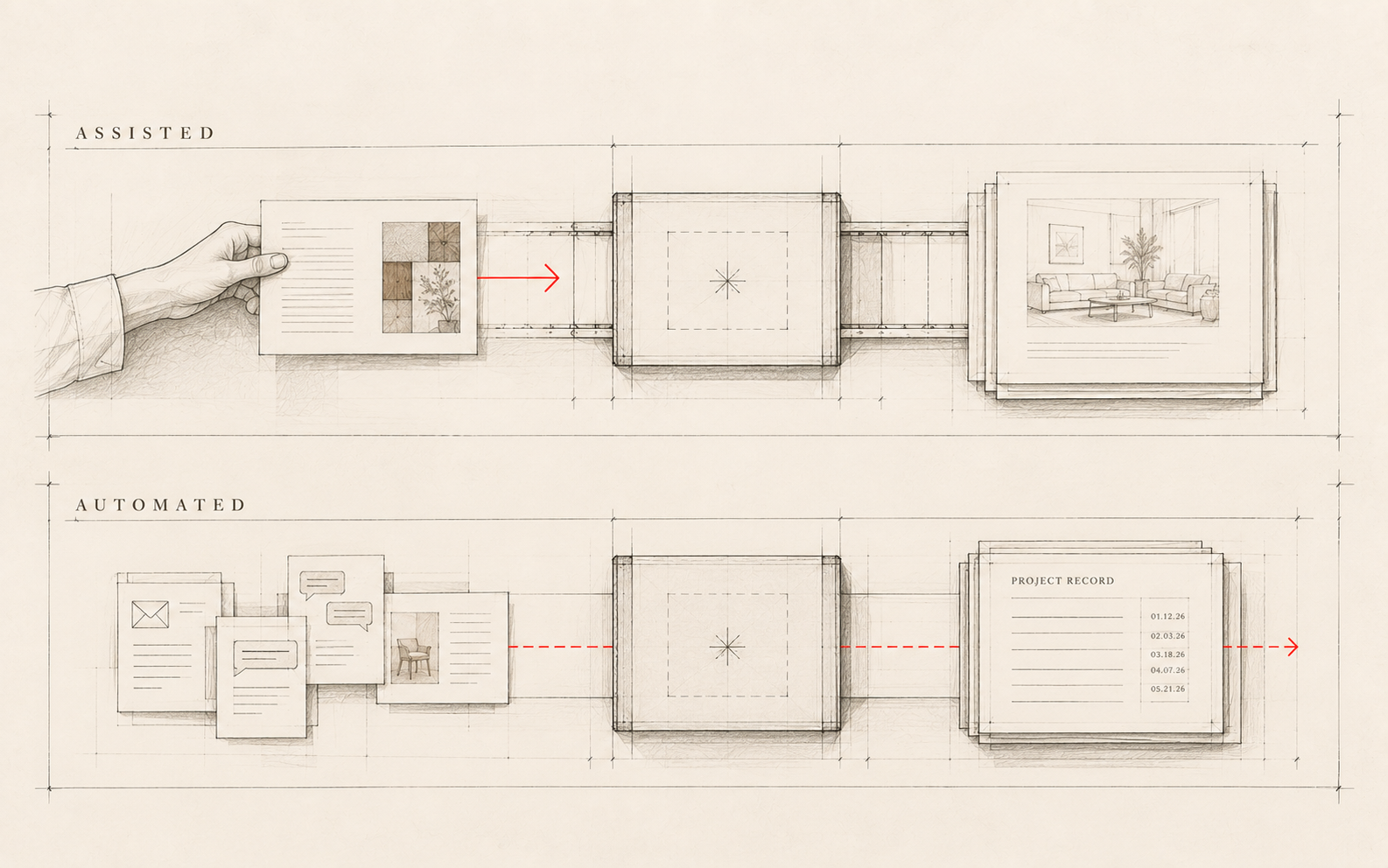
The Silent Liability
Every project-based organization carries a liability that doesn't appear on any balance sheet. It accumulates invisibly, across every meeting that ended without minutes, every client approval that lived in a text thread, every design decision that made perfect sense to the person who made it. It disappeared with them.
We call it Decision Debt. The accumulated cost, measured in rework, disputes, failed handoffs, and lost revenue, that results when decisions are made but not captured, preserved, and made accessible to the people who need them.
Like its software cousin, Technical Debt, it accrues interest. An undocumented verbal approval today becomes a scope dispute six months from now, which becomes an absorbed loss that never appears in any analysis of what went wrong.
The built world (architecture, interior design, construction, fabrication) is where Decision Debt is most expensive, because physical projects compound errors rather than reversing them. But the pattern is structural, not sectoral. Healthcare, law, and professional services carry versions of the same liability.
The primary audience for this paper is design firm principals and operations leaders. If you recognize your own practice in these pages, that recognition is the point. You now have a name for something you've been absorbing for years.
$31.3B
Lost to miscommunication and poor data in US construction annually (FMI/PlanGrid, 2018)
48%
Of all construction rework caused by information and communication failures (FMI/PlanGrid, 2018)
20%
Of the working week spent searching for information that should already be findable (McKinsey Global Institute, 2012)
Part One: The Problem Has a Name Now
A Decision Gets Made
It happens somewhere between 9 and 10 on a Tuesday morning. The client is on a call. The designer has pulled up a finish sample. Someone says let's go with the lighter oak and the conversation moves on. Fabrication quotes get requested. Lead times confirmed. A purchase order goes out.
Six weeks later, the client says they never approved that finish. They thought they were looking at the walnut.
What follows is not primarily a conflict about oak versus walnut. It is a conflict about what was decided, by whom, and when. Because the decision lived in no system (not in an email thread anyone can find, not in a signed document, not in a shared record), the conflict has no resolution mechanism except time, relationship capital, and someone absorbing the cost.
This scenario has a hundred variations. A scope change discussed in a site walkthrough. A budget ceiling agreed to verbally in a preliminary meeting. A substitution approved over the phone. An iteration the client said was "perfect" in a presentation that no one captured as a formal approval.
“Each of these is a decision. Each of them, left undocumented, is debt.”
The Concept: Decision Debt Defined
In 1992, software engineer Ward Cunningham introduced the concept of Technical Debt at the OOPSLA conference. He described the future cost of choosing expediency over correctness in code. A quick shortcut that ships on time creates a latent problem: one the team will have to pay back, with interest, when the shortcut collides with the next feature or the next hire. The longer you wait, the more it compounds.
Technical Debt gave engineers language for something experienced intuitively: choosing not to do something correctly now doesn't make the problem go away. It defers it, and charges interest while it waits.
Decision Debt is the same mechanism applied to knowledge work. Every time a decision is made without being captured in a form that is retrievable, transferable, and durable, it creates a liability. The principal who carries the project history in her head is also carrying the firm's Decision Debt. When she takes on a fourth project, or gets sick, or hires a junior designer who has to reconstruct what clients approved, that debt comes due.
Decision Debt is distinct from disorganization, though the two are often conflated. A highly organized firm can still carry substantial Decision Debt if its systems are built for task tracking rather than decision capture. The project folder with every drawing, every spec sheet, and every invoice has none of the approval trails, the rationale, or the conversation history. It is organized. It is not a memory.
Like Technical Debt, Decision Debt accrues interest. Like Technical Debt, it is not unique to struggling organizations. Some of the best-run firms in the built world carry significant Decision Debt because the tools of their industry were not built to prevent it.
1992
Ward Cunningham coins Technical Debt at OOPSLA, giving software engineers language for a problem they had been absorbing for decades. Decision Debt is the same mechanism, applied to knowledge work across every project-based industry.
Part Two: How Decisions Disappear
Organizations have six distinct "retention bins" where knowledge lives. Most project decisions occupy exactly one: individuals. When that individual is unavailable, the decision is unavailable.
The Organizational Memory Framework
In 1991, management scholars James Walsh and G.R. Ungson published a landmark paper in the Academy of Management Review that formalized what they called organizational memory. Their framework identified six distinct retention bins where organizational knowledge lives.
- Individuals: Experience, judgment, and tacit knowledge held by specific people. The most fragile bin: it exits with the person.
- Culture: Shared stories, norms, and mental models embedded in a team's way of working.
- Transformations: Processes and procedures that encode past decisions into operating routines.
- Structures: Roles and reporting relationships that carry implicit knowledge about how decisions get made.
- Ecology: The physical workspace and its spatial cues. Often lost when teams move or go distributed.
- External Archives: Formally documented records, files, and databases. The only bin designed to outlast any individual.
Walsh and Ungson's insight was that organizations remember through all bins simultaneously, and when any one degrades, memory degrades with it. The critical implication for Decision Debt: most project decisions in knowledge-intensive work are stored in exactly one bin: individuals. When that person is unavailable, the decision is unavailable. When they leave, the decision leaves with them.
Transactive Memory: Who Knows What We Know
Research on transactive memory systems, developed by psychologist Daniel Wegner and extended extensively in organizational behavior literature (Ren & Argote, Academy of Management Annals, 2011), demonstrates that teams do not store knowledge uniformly. Instead, they develop implicit maps of who knows what and rely on those maps to retrieve information they don't individually hold.
A design team functions this way intuitively. The senior designer knows the client's preferences. The project manager holds the budget constraints. The vendor relationship manager knows which fabricators have delivered. The team's shared knowledge isn't centralized: it's distributed across a map of people.
Transactive memory works well until the map breaks. A team member leaves. A new hire arrives who doesn't know who to ask. A project transfers to a different team. The knowledge that depended on one person becomes inaccessible even if it theoretically exists somewhere in the organization.
“What transfers is the artifact. What stays behind is the decision.”
The Tools Were Not Designed for Memory
The persistence of Decision Debt across decades and industries is not a failure of discipline. It is a structural consequence of which problems the tool landscape was built to solve. Project management software was built for task tracking. Email captures messages, not decisions. Design software captures outputs, not conversations. Communication platforms make decisions effectively unsearchable over time.
“An archive is storage. Knowledge is retrieval.”
There is a robust tool ecosystem for creating work, communicating about work, and tracking work. There is almost nothing for remembering it. That is the gap this paper names.
Part Three: The Hidden Costs
Decision Debt doesn't announce itself. It appears as rework absorbed without a clear cause, scope disputes with no resolution mechanism, a profitability picture nobody can explain, and knowledge that walks out the door with a departing senior.
5-10%
Rework as a share of total project cost in residential construction (Mahamid, 2024)
$31.3B
Annual US construction losses: $17B from miscommunication, $14.3B from poor project data (FMI/PlanGrid, 2018)
52%
Of all construction rework is preventable through better data practices (Autodesk/FMI, 2021)
Rework: The Visible Tip
The most measurable downstream cost of Decision Debt is rework: the repetition of work already completed because the original decision was not preserved, understood, or honored. In the construction and design sector, rework costs are well-documented: 5 to 10% of total project cost in residential construction (Mahamid, 2024). Across the broader US construction industry, poor project information and communication account for an estimated $31.3 billion in lost labor annually (FMI/PlanGrid, 2018).
These are not abstract figures. They represent drawings revised because a client approval was understood differently by designer and client. Fabrications remade because a decision made during design was never communicated to production. The largest single preventable cause is not bad design, not contractor failure. It is information management.
48%
Of all rework in construction and design is attributable to communication and information failures, making it the single largest preventable cause category across the industry. (FMI Corporation / PlanGrid, Construction Disconnected, 2018, n=599 construction leaders)
Scope Creep: The Accumulating Debt
Scope creep is the form of Decision Debt that principals in the built world know most immediately. Seventy-three percent of architecture and engineering firms identify scope creep as their primary budget killer (Monograph 2026). The evidence on how documentation practices affect outcomes is direct:
60%
Fewer late-stage revisions in firms requiring formal written approvals at each design phase (Architectural Record / Monograph)
40%
Fewer scope disputes in projects with structured kickoffs involving all decision-makers (PSMJ Resources / Monograph)
95%
More additional services revenue captured by firms with disciplined change order processes (Zweig Group / Monograph)
“Sixty percent fewer revisions. Forty percent fewer disputes. Ninety-five percent more revenue captured. The difference is not talent. It is memory.”
The Information Tax on Knowledge Work
Decision Debt imposes a daily productivity cost that operates independently of any single project failure. McKinsey's research on knowledge work productivity found that interaction workers spend approximately 20% of the working week searching for internal information or tracking down colleagues who hold it (The Social Economy, McKinsey Global Institute, 2012). The IDC estimates knowledge workers spend approximately 30% of their working day on information retrieval activities (Feldman & Sherman, IDC, 2001).
For a design principal managing a five-person studio, 20% of a 40-hour week is eight hours: a full working day spent reconstructing context that, in a properly designed system, would already be findable. This is not time spent designing. It is time spent paying down Decision Debt.
42%
Of A&E firms cannot report their own net profit margin (Monograph 2026, 856+ A&E firms)
60%
Don't know or don't track their realization rate: billable hours that convert to collected revenue (Monograph 2026, 856+ A&E firms)
70%
Manage project resources through meetings, spreadsheets, or no formal process at all (Monograph 2026, 856+ A&E firms)
“Decision Debt makes the firm illegible to itself.”
The profitability blind spot and the decision documentation gap are not two separate problems. They are the same problem at different points in its lifecycle. A firm that cannot measure project profitability in real time cannot trace where its margins are eroding back to the undocumented client approvals that started the rework spiral.
Knowledge Loss on Transition
The most irreversible form of Decision Debt is the knowledge that walks out the door with a departing team member. In most small professional services firms, individual memory functions as the primary organizational memory bin. Project history, client preferences, vendor relationships, and the reasoning behind past decisions all live in the minds of senior staff.
In the construction sector specifically, approximately 22.7% of workers were age 55 or older in 2020, nearly double the 11.5% share recorded in 2003 (Bureau of Labor Statistics, 2022). The retirement wave underway is not just a labor shortage: it is a knowledge hemorrhage. Every retiring senior professional carries decades of project decisions and contextual judgment that formal systems were never built to capture. Research published in The Learning Organization (Galan, 2023) confirms that the losses are not recoverable through new hiring alone.
Part Four: The Built World
In software, a bad decision can be reversed. In the built world, decisions become physical facts. The wrong finish gets milled. The tile gets set. The structure gets poured. At each juncture, an undocumented decision becomes a cost to absorb, a timeline to extend, or a client relationship to repair.
Why Physical Projects Are Uniquely Vulnerable
Decision Debt accumulates in every knowledge-intensive industry. But the built world bears a compounding burden that makes it uniquely exposed. Physical projects also span longer timelines than most other project types, which means the interest rate on Decision Debt is higher. A decision made in schematic design may not manifest as a problem until construction documentation: months later, with a team that may have partially turned over, a client whose memory has faded, and a budget already committed in ways that make change expensive.
56.5%
Of cost overruns and 40% of delays in large-scale construction projects are attributable to design errors and omissions. Many of them are documentation failures, not technical ones. The work was competent. The record of the decision was not. (Engineering, Technology & Applied Science Research, 2025, peer-reviewed, n=127 practitioners)
Architecture and Engineering
Architecture firms operate where the gap between what is known and what is captured is structurally wide. Projects involve multiple stakeholders with different interests, extended timelines, and delivery through contractors who were not present when decisions were made.
The 2026 Monograph A&E Industry Benchmark (compiled from anonymized data across 856+ A&E firms and more than 15,000 professionals) documents the operational consequence: 40% of A&E firms lack real-time project profitability tracking, 50% assign staff based on intuition rather than data, and 44% identify project management overhead as the primary distraction from billable design work.
Only 12% of construction firms consistently incorporate project data into their decision-making (Autodesk/FMI, 2021). The other 88% make decisions in the present tense, without the benefit of documented historical context.
Interior Design and the Micro-Studio
The interior design sector compounds the built world's structural challenge with a size constraint. Approximately 98.6% of US interior design firms have fewer than 10 employees; 77% are solo practitioners (ASID, 2025). In a firm of one to three people, there is no separation between the person who makes decisions and the system that records them. They are the same person.
In this context, Decision Debt is not a management failure: it is the default operating mode. The solo designer carries the project in their head because there is no time to do otherwise, and no system designed for the scale at which they operate. The cost becomes visible in specific moments: the client who claims they never approved the furniture they're now sitting on. The fabricator who milled to a spec superseded in a client call no one documented. Every one of these moments is Decision Debt coming due.
Construction and Fabrication
Further along the supply chain, construction and fabrication firms bear the Decision Debt that originates upstream. A fabricator working from a design specification never updated after a client-approved change. A subcontractor operating on instructions accurate as of two weeks ago, before a site meeting that generated five decisions no one sent back to the shop.
The 2021 Autodesk/FMI study estimated that bad data in construction caused $88.69 billion in rework globally in 2020. The work was done correctly. It was done to the wrong specification.
The construction sector has invested heavily in Building Information Modeling (BIM), which accounts for 31.9% of the AEC software market in 2025 (Grand View Research). But BIM models the building, not the decisions that shaped it. The rationale for a structural choice, the client's override of an engineer's recommendation, the cost-driven substitution approved on a Friday afternoon: these live outside the model, in the same email threads and individual memories where they always have.
98.6%
Of US interior design firms have fewer than 10 employees: no separation between decision-maker and record-keeper (ASID, 2025)
$88.7B
In global construction rework from bad data in 2020. The work was correct. The specification was not. (Autodesk/FMI, 2021)
88%
Of construction firms make decisions without documented historical context: present tense only (Autodesk/FMI, 2021)
Part Five: Not Just Design
Decision Debt is not a design industry problem. It is the predictable consequence of project-based knowledge work, wherever teams make decisions that outlive the meeting in which they were made.
Healthcare: When Memory Failure Costs Lives
Healthcare handoffs (the transfer of patient care from one clinician to another) are among the most studied decision handoff events in any field, because the consequences of failure are immediate and severe.
A 2025 systematic review published in Annals of Internal Medicine (covering 46 studies, 67,639 patients, and five continents) found that poor communication contributed to 24% of patient safety incidents and was the sole identified cause in 10% (Keshtkar et al., 2025). The AHRQ identifies communication failures as "the leading root cause of sentinel events reported to the Joint Commission from 1995 to 2004" (AHRQ, 2008). A finding consistently replicated across subsequent decades.
The mechanism in healthcare is structurally identical to the mechanism in design: a decision about a patient's care, made in one context by one set of clinicians, fails to transfer with fidelity to the next care context. The night shift doesn't know what the attending decided this morning. Healthcare has responded with structured handoff protocols and extensive training. The built world has not yet built its equivalent.
24%
Of patient safety incidents had poor communication as a contributing cause (Keshtkar et al., Annals of Internal Medicine, 2025, n=67,639 patients)
30%
Of team exchanges in operating room studies involved communication failures (AHRQ / NIH)
1.8x
Increase in patient risk-adjusted mortality linked to poor nurse-physician collaboration in ICUs (AHRQ / NIH)
Law: Matter Knowledge as Institutional Asset
In legal practice, the knowledge most at risk is matter knowledge: the context, strategy, precedent, and client relationship history that accumulates over the course of representing a client. When the relationship partner retires, or the associate who built the institutional familiarity leaves for another firm, the matter knowledge does not transfer with the file. The file transfers. The knowledge does not.
The profession has historically addressed this through longevity: the long-tenured partner who carries the institutional history in their person. As legal workforce demographics shift and client relationships diversify across increasingly mobile attorney populations, this approach is becoming structurally untenable.
Professional Services: The Universal Pattern
Across professional services (management consulting, marketing agencies, engineering firms, accounting practices) the same structural conditions produce the same pattern. Project-based delivery generates knowledge in the context of projects; that knowledge has no natural home between projects; and when the project ends, the knowledge either lives in individual memories or it disperses.
Research on knowledge transfer in project-based organizations consistently identifies "phase transition losses" as among the most damaging knowledge failure modes: the evaporation of decision context at the boundaries between project phases. What passes through is the artifact. What stays behind is the decision trail that explains why it looks the way it does.
“McKinsey's estimate that knowledge workers spend 20% of the working week searching for information they should be able to find represents a tax levied at precisely these transition points.”
Part Six: The Missing Layer
The modern professional's tool stack is exceptional for creating, communicating, and tracking work. It has a categorical gap: no tool category exists specifically for remembering it.
What the Tool Stack Is Missing
The reason Decision Debt compounds is not a failure of the tools that exist. It is the absence of a tool category that doesn't yet exist at scale: organizational memory.
Walsh and Ungson's six retention bins reveal the structural gap. Most tool investment in project-based work targets task tracking (transformations), file storage (external archives), and communication (the channel for knowledge exchange between individuals). The individual retention bin, where the majority of project decisions actually live, is addressed only by the humans themselves, with no systematic support for externalizing what they know into a form the organization can use.
- Email: Captures messages. Finding a decision requires already knowing what was said, when, and by whom. That requires the institutional memory you are trying to reconstruct.
- Project Management: Tracks task states: open, in progress, complete. Does not capture the reasoning behind scope changes or the context behind approval decisions.
- File Storage: Documents what was produced. Says almost nothing about why. The approval, the rationale, the conditional agreement that shaped everything after.
What Organizational Memory Changes
When organizational memory is treated as infrastructure rather than afterthought, the compounding of Decision Debt reverses into the compounding of institutional knowledge. A firm with organizational memory doesn't lose a client's preference history when a senior designer goes on leave. It doesn't reconstruct the same scope conversation three times across the life of a project. It doesn't absorb a rework cost because the fabricator was working from a specification updated verbally but never formally recorded.
Perhaps more importantly, a firm with organizational memory becomes legible to itself. When decisions are captured, the chain of cause and effect becomes visible: this approval, this scope change, this unrecorded substitution, traceable to this margin compression. The firm can learn from its projects, not just complete them.
25%
Potential productivity improvement for interaction-intensive workers with better knowledge retrieval systems: roughly one additional billable day per person per week for a five-person design studio. (McKinsey Global Institute, The Social Economy, 2012)
Conclusion: You Have a Name for It Now
Decision Debt is not a new phenomenon. It has been accumulating in every project-based organization for as long as projects have been undertaken by teams. What is new is the name: and the recognition that accumulating it is not inevitable.
Technical Debt became a transformative concept in software engineering not because it described a new problem, but because it gave engineers language to explain the problem to people who hadn't experienced it directly. Once the concept existed, you could measure it, budget for it, and make deliberate choices about when to incur it and when to pay it down.
Decision Debt offers the same leverage. A design firm principal who recognizes that her practice is carrying Decision Debt (those verbal approvals from last month's client call are a liability on her firm's books, not just a fuzzy memory) can begin to make different choices. Not because the principle is new, but because the concept makes it possible to see what was always there.
The tool category that addresses Decision Debt is what we call organizational memory: the infrastructure layer that sits between the work of making decisions and the archives of what was produced. It is the layer that captures the why, preserves it in a form that is findable and transferable, and allows the firm's knowledge to compound over time rather than reset with every project, every handoff, and every departure.
This category is early. The software built for construction coordination, project tracking, and design production has no mainstream equivalent built specifically for decision memory in the built world.
Archen™ is building that infrastructure: a project memory system designed specifically for the operational realities of design firms, architectural practices, and the studios that create and manage physical spaces. It is the first product built around the premise that a firm's decisions are its most valuable and most underprotected asset.
“If you finished this paper and thought 'we have this problem', that recognition is the beginning of paying the debt down.”
Methodology & Source Notes
This paper draws on published peer-reviewed research, major research firm surveys, industry benchmarking reports, and government data. Sources are cited inline by institution, publication, and year.
- Tier 1 (cited freely): Peer-reviewed academic journals, government agencies (AHRQ, BLS), credentialed association primary research.
- Tier 2 (with source notation): Major research firms (McKinsey, FMI, Autodesk), established trade publications with disclosed survey methodology.
- Tier 3 (signal only): Practitioner literature, single-source claims without disclosed methodology. Never used as sole support.
Selected References
- Walsh, J.P. & Ungson, G.R. (1991). Organizational Memory. Academy of Management Review, 16(1), 57-91.
- Ren, Y. & Argote, L. (2011). Transactive Memory Systems 1985-2010. Academy of Management Annals, 5(1), 189-229.
- Reich, B.H. (2008). Modeling the Knowledge Perspective of IT Projects. Project Management Journal, 39(S1), S4-S14. doi:10.1002/pmj.20056.
- Keshtkar, L. et al. (2025). Impacts of Communication Type and Quality on Patient Safety Incidents. Annals of Internal Medicine, 178(5). n=46 studies, 67,639 patients.
- FMI Corporation and PlanGrid (2018). Construction Disconnected. Survey of 599 construction leaders.
- Autodesk and FMI (2021). Harnessing the Data Advantage in Construction.
- Monograph (2026). A&E Business Benchmarks. Derived from 856+ A&E firms, 15,000+ architects.
- McKinsey Global Institute (2012). The Social Economy: Unlocking Value and Productivity Through Social Technologies.
- AHRQ (2008). Improving Patient Safety Through Provider Communication Strategy Enhancements. In Advances in Patient Safety, Vol. 3.
- Mahamid, I. (2024). Rework in residential construction. Construction Engineering and Management research literature.
- ASID (2025). State of Interior Design Report.
- Galan, N. (2023). Knowledge loss induced by organizational member turnover (Parts I & II). The Learning Organization, 30(2), 117-136+. Emerald Publishing. doi:10.1108/TLO-09-2022-0107.
- Cunningham, W. (1992). The WyCash Portfolio Management System. OOPSLA '92 Addendum to the Proceedings.
- Feldman, S. and Sherman, C. (2001). The High Cost of Not Finding Information. IDC White Paper. Sponsored by Inktomi.
- Monograph (n.d.). Proven Strategies to Manage Project Scope Creep. Blog post. Secondary source for Architectural Record (60% fewer revisions), PSMJ Resources (40% fewer scope disputes), and Zweig Group (95% more additional services revenue) statistics.
- Bureau of Labor Statistics (2022). The Construction Industry: Characteristics of the Employed, 2003-20. BLS Spotlight on Statistics.
- Grand View Research (2024). AEC Software Market Size, Share & Trends Analysis Report. Market share figure cited for 2025 projection.
- Cumberland, D. (2026). AEC Project Management's Hidden Risk: The Memory Problem. Dan Cumberland Labs. Published August 3, 2026.
Copyright 2026 Archen™. This paper may be shared freely with attribution. For inquiries about Archen™'s organizational memory platform, visit archen.io.