There is an asset every design firm has. It is not the portfolio. It is not the client relationships. It is not the team.
It is the project history. The accumulation of every decision, every approval, every material choice, every client preference, every hard conversation, every change, every "this is what we decided and here is why" across every project the firm has ever run.
It is the most valuable thing the firm has. And at most design studios, it lives in one person's head.
What knowledge loss costs at scale
The enterprise world has studied this problem, even if a precise dollar figure is hard to pin down. Industry analysts have estimated that as much as half of corporate knowledge cannot be located centrally within an organization, forcing employees to recreate information that technically already exists somewhere in the company (IDC data, as cited by Iterators, 2024).
That figure covers large organizations with structured HR practices and knowledge management systems. The mechanisms for knowledge loss at a five-person interior design studio are the same. The scale is smaller. The consequences, relative to firm size, are not.
At a Fortune 500, when a senior employee leaves, the organization has redundant systems, institutional documentation, and a team that can reconstruct what was lost. At a five-person studio, when the most experienced designer departs mid-project, there is often nothing to reconstruct from. The project history left with her.
The interior design knowledge gap is unmeasured
Here is what is notable about this problem: no study has measured knowledge loss specifically within interior design firms.
No ASID report. No AIA survey. No published academic study. The industry statistics are well-established: 77% of US interior design firms are solo practitioners, and 98.6% have fewer than 10 employees. (ASID, 2025.) But the cost of knowledge loss at this scale has never been quantified.
This is not because the problem does not exist. It is because the firms experiencing it do not have the systems to measure it.
A solo practitioner has eight active projects in her head. She knows which client prefers cool-toned lighting, which project has a pending approval on the millwork, which contractor is likely to push back on the tile change. This is institutional knowledge. It is valuable. And it is externalized in no document anywhere.
“This is institutional knowledge. It is valuable. And it is externalized in no document anywhere.”
When she hires her first employee, that employee has access to the portfolio and the client list. She does not have access to the context. The decisions made before she arrived. The preferences that shaped each project's direction.
She has to ask. The principal has to remember and explain. The whole cycle takes time neither of them has.
A new knowledge loss vector
A July 2026 post from designDATA surfaced something worth paying attention to. Firms adopting AI tools are creating a new form of institutional knowledge loss: AI-generated workflows and custom processes exist in individual employee accounts. When the employee leaves, those processes leave with them. (designDATA, July 2026. Practitioner signal, not peer-reviewed.)
The knowledge loss problem is not improving with technology adoption. It is getting more complex.
What good looks like
The firms that handle knowledge loss well are not necessarily bigger or better funded. They have built the habit of externalizing decisions as they happen. Not in a retrospective documentation session at the end of the project. Not in the handoff document written three days before the next hire starts. In the moment, as the project moves.
The goal is not a perfect archive. It is a retrievable one. A record that the next person can use to reconstruct context without starting from memory.
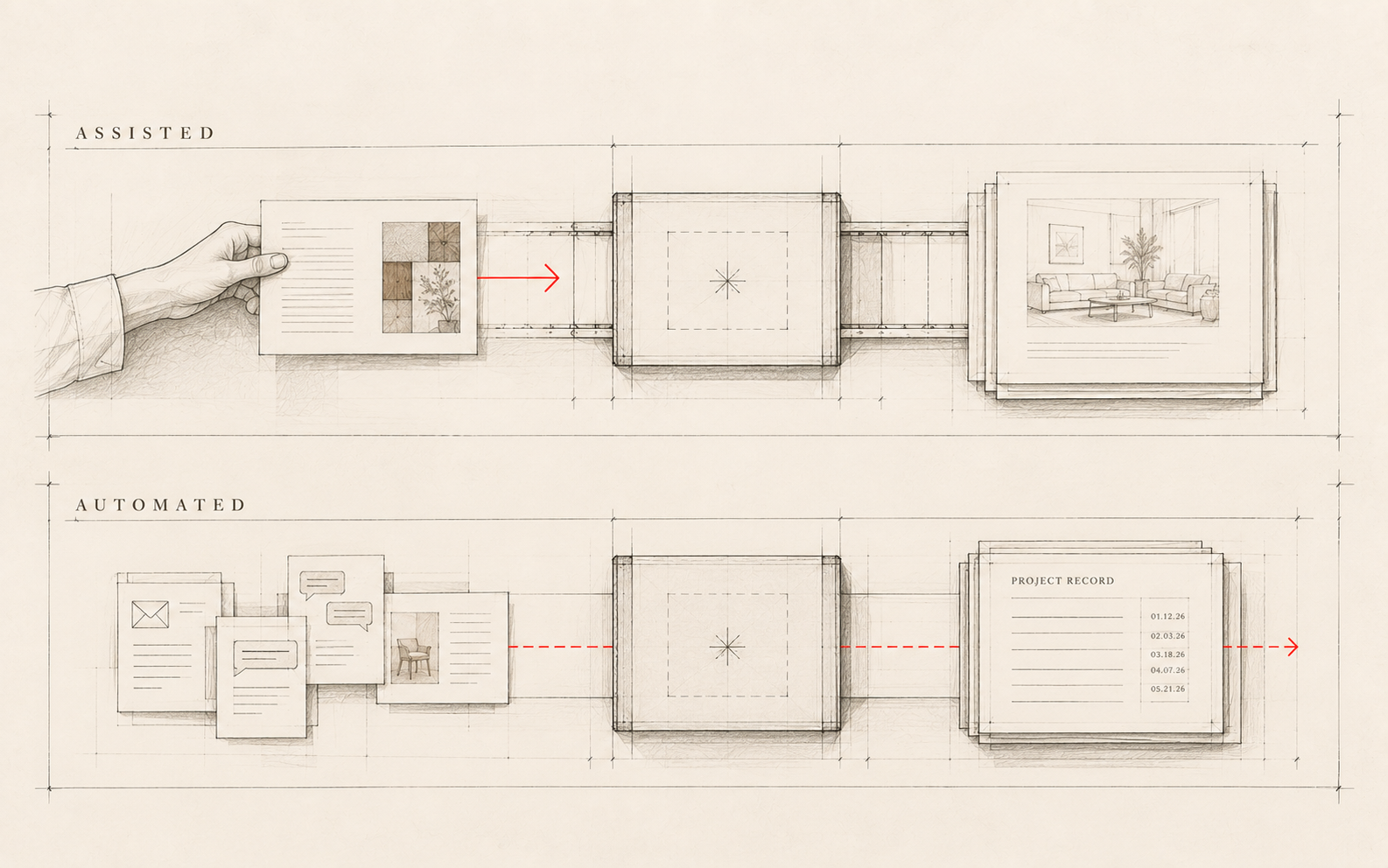
Archen™ is designed for this failure mode. It captures project history automatically, from your existing communications, as the project moves. The asset stays with the firm, not with whoever happened to be in the room when the decision was made.