There is a number that design firm principals rarely look at directly. Most would rather not.
Here it is: if you are a principal at a five-person design studio with significant operational responsibilities, you are probably billing somewhere between 10 and 15 hours per week. Out of 40. (Scarlet Thread Consulting, 2022. Directional benchmark, not peer-reviewed.)
That is a 25 to 37 percent billable utilization rate.
“The most senior person in the firm is often the least billable.”
The utilization gap is not a discipline problem
The architecture and engineering industry publishes better data on this than interior design does. The most rigorous available source is the Monograph 2026 Architecture and Engineering Business Benchmarks Report, compiled from anonymized data across 856 firms and more than 15,000 professionals.
The industry average across all staff: 81% billable utilization. Top-quartile firms reach 92 to 94 percent. Bottom-quartile firms land at 67 to 70 percent. (Monograph, 2026)
Billable utilization by firm tier
% billable utilization
Source: Monograph 2026
The gap between the best and the worst firms is not about how hard people work. It is about systems.
Top-quartile firms have built the infrastructure to keep their people on billable work. Bottom-quartile firms have not, and the hours that should be billable disappear into coordination, communication, and search.
For design firm principals, the picture is often worse than the average architecture firm. A managing principal with a full client roster and no dedicated operations support is likely spending 25 or more hours per week on work that is not billable. Answering client questions that should be in the file. Tracking down approvals from three months ago. Briefing a team member on a decision that should already be documented.
Where the time goes
The FMI/PlanGrid "Construction Disconnected" study found that the average construction professional loses more than 14 hours per week to three activities: hunting for project data, conflict resolution, and managing rework. (FMI/PlanGrid, 2018. Note: from the construction sector broadly, not interior design specifically. Use as directional proxy.)
That is more than 35 percent of a 40-hour week gone to work that produces nothing.
For design principals, the specific time sinks differ from a site superintendent's. But the mechanism is identical. Searching for information that should already be accessible.
A 2025 Houzz State of the Industry report surveyed more than 1,500 interior design professionals. It found that 39% identified client and team communication improvement as one of their top three strategic investment priorities. (Houzz, 2025)
A firm telling that to a survey is a firm saying: enough time goes to communication overhead that they have identified it as a category worth paying to fix.
The one-client math
There is a practical way to frame this.
If a studio principal is billing 12 hours per week when she could be billing 20, that is a gap of 8 hours. Over a 12-week project cycle, that is 96 hours. At $175 per hour, roughly $16,800 in recoverable revenue. For a firm running three active projects, the annual number compounds quickly.
The constraint is not available client work. It is available principal time.
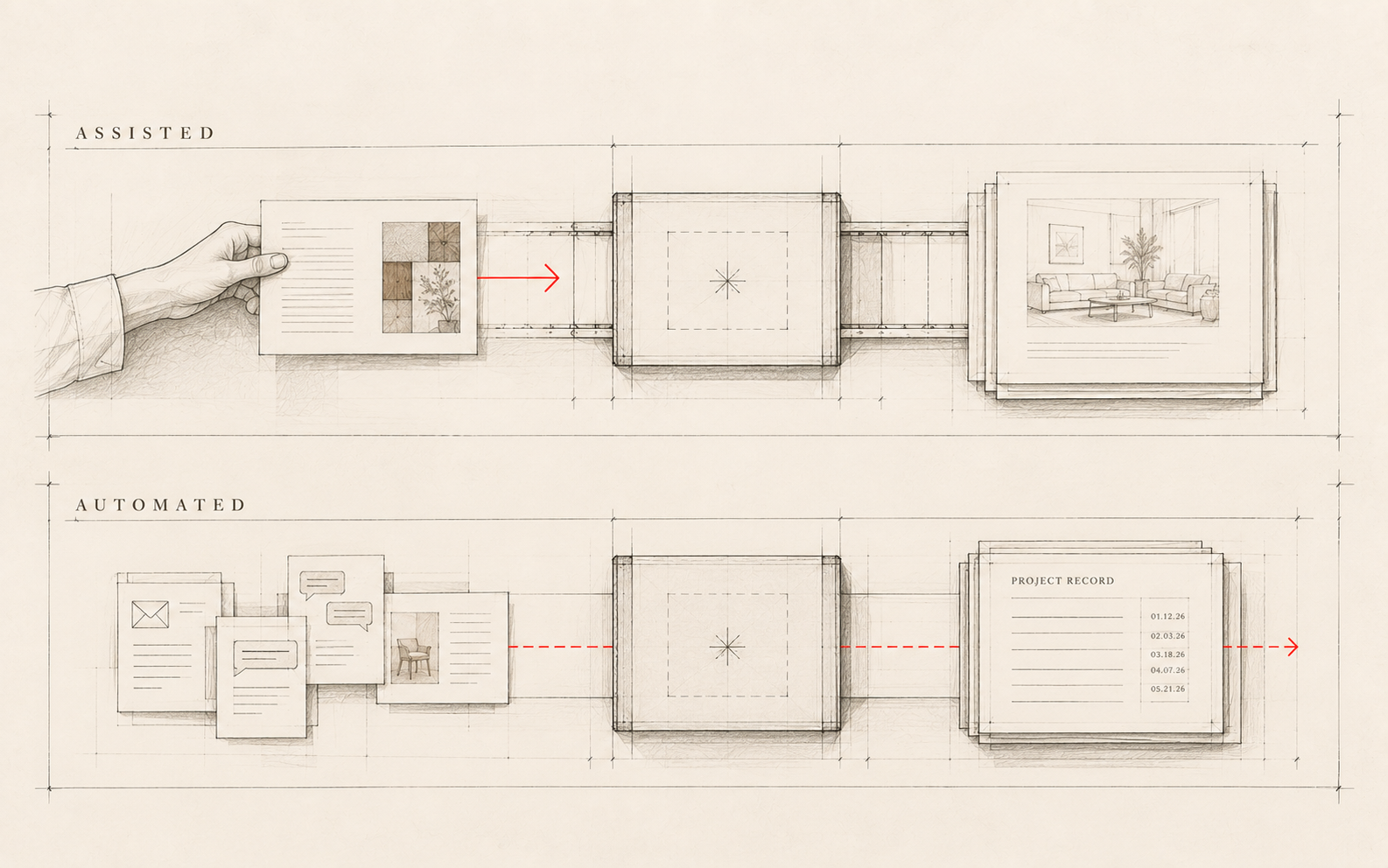
The firms that close this gap are not working longer hours. They have reduced the time spent on search, coordination, and information reconstruction. They have built systems that make the answer accessible before someone has to hunt for it.
What this tells us about where to focus
For most design firms, the highest-leverage improvement available is not in design quality, client acquisition, or team size. It is in operational infrastructure.
The tool that saves a principal 5 to 8 hours per week on coordination does not just improve the firm's profitability. It changes what that principal is able to do with her time.
Archen™ reduces that coordination overhead. The record builds itself from your existing project communications. The time it returns is yours.