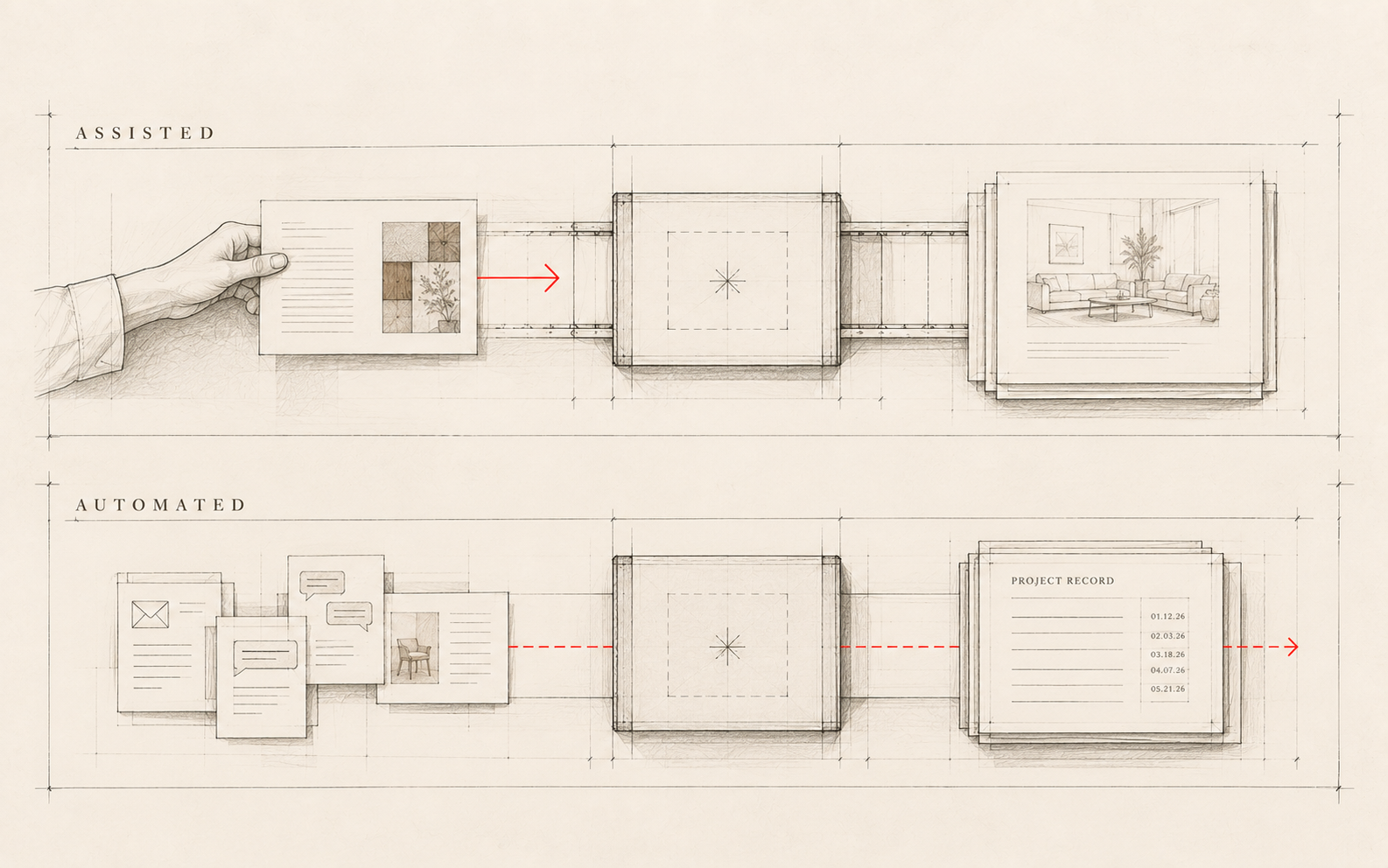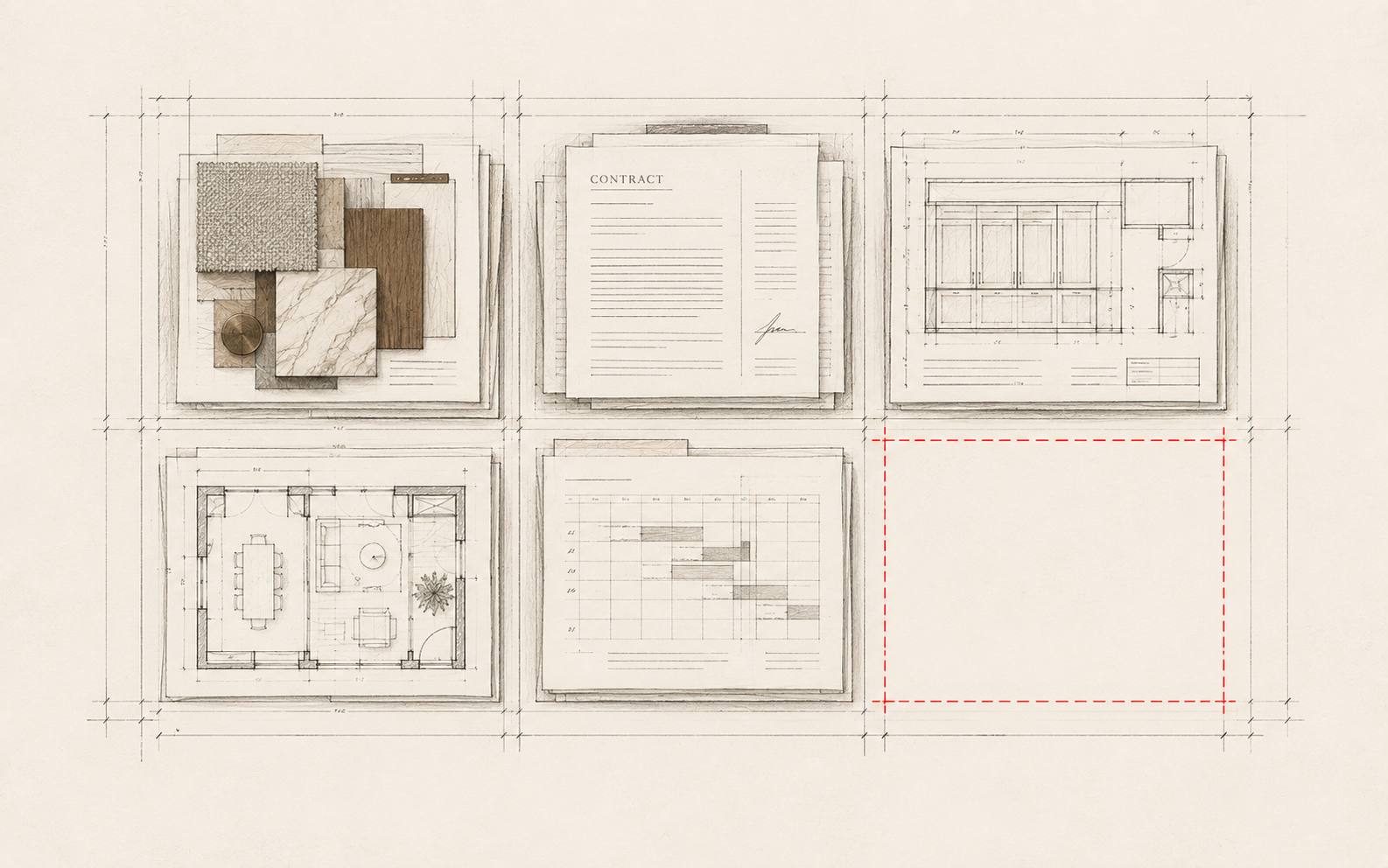
Most design firms have a process for getting client approvals. Almost none have a system for proving they got them.
That gap is where disputes come from. Not from bad work. From a yes that nobody wrote down.
Getting an approval is a conversation. Tracking one is a record. They are not the same skill, and most studios only practice the first. They are good at reading the room, closing the decision, and moving the project forward. Then they log off and start the next thing, and the record of what just got decided never gets made.
Firms that require formal written approvals at every design phase have 60% fewer late-stage revisions (Architectural Record) and 40% fewer scope disputes (PSMJ Resources), as cited in Monograph's scope creep analysis.
The cost of a missing approval is rarely just the argument. It is the delayed payment while the argument runs, the hours your team spends reconstructing what happened, and the strain on a client relationship that was fine until the invoice arrived. One undocumented yes can undo the goodwill of an entire project. Tracking is not paperwork. It is how you get paid on time and keep the relationship intact.
This is the tracking side, step by step, in a form that holds up six months later when memory fails on both sides.
Why Tracking Approvals Is Different From Getting Them
Getting an approval means the client said yes. Tracking an approval means you can prove what they said yes to, when, and on which version. When a dispute surfaces, the yes is not what protects you. The record of the yes is.
This distinction sounds small until it costs you. A client approves a finish on a Thursday call. Everyone on the call hears it. Six weeks later, at install, the client does not remember approving it. They are not lying. They simply never made a record either, and neither did you. Now it is your memory against theirs, and memory is not evidence.
The firms that avoid this moment are not better at getting decisions. They are better at capturing them. The approval and the record of the approval are two separate jobs, and the second one is the one that protects the firm.
Tracking also changes how you bill. When every approval is documented, additional services stop being an awkward conversation. The client asked for the extra sconces in an email you captured, you confirmed the added cost, and the record is right there when you invoice. Firms with a clean approval trail bill for more of the work they actually do, because they can show what was agreed to instead of hoping the client remembers agreeing to it.
The Five-Step Approval Tracking System for Interior Design Firms
This system is platform-agnostic. It works with whatever tools you already use. The point is not the software. It is the discipline of turning every decision into a dated, retrievable record before the project moves on.
Follow all five and the record builds as the project runs, so you are never reconstructing a decision after the fact. Skip one, and that skipped step is usually where the disputed approval slips through. The steps are ordered, but the habit is what matters: each one turns a moment that would have lived only in memory into something you can point to later.
Step 1 - Define What Counts as an Approval Before the Project Starts
Decide, before the work begins, which decisions require a formal client approval: budget, schedule, material and finish selections, custom fabrication, and any change to signed scope. Write that list into your onboarding so the client knows what a yes commits them to. An approval you never defined is one you cannot enforce.
Most firms skip this step and pay for it later. When everything is informally an approval, nothing is clearly an approval. Naming the categories up front does two things. It sets the client's expectation that these specific decisions are gates, not casual chatter. And it gives your team a checklist, so nobody has to guess whether a given moment needed to be documented. The list can be short. It just has to exist before the project starts, not after the first dispute.
Step 2 - Send a Written Recap Within 24 Hours of Every Decision
After every approval, send a short written recap within a day: what was approved, the specific item, and the date. Two sentences is enough. The recap turns a verbal yes into a written record while the details are fresh and the client still remembers the conversation.
The timing is the part firms get wrong. A recap sent within a day, while the client's memory matches yours, is a confirmation. A recap sent three weeks later, when the client has moved on, reads like a challenge and often reopens the decision you already closed. Speed is what makes this work. The email does not need to be formal. It needs to be sent. "This confirms your approval of the quartz island top we selected today. We will place the order Friday." That sentence, sent before end of day, is a record that will still be there when you need it.
Step 3 - Store Every Approval in One Place (Not a Folder, a System)
Keep every approval in one searchable place tied to the project, not scattered across inboxes, phones, and personal notes. A folder is where approvals go to get lost. A system lets you pull any decision in seconds, by project, by date, or by item, when you actually need it.
The difference between a folder and a system is retrieval. A folder holds files. A system answers questions. When a client asks what was approved for the primary bath in March, a folder makes you go hunting through email threads and file names. A system gives you the answer and the proof in one search. Most firms have the approvals somewhere. What they do not have is a way to find the right one under pressure, which is the only time it matters.
Step 4 - Timestamp and Name Every Approval
Every approval needs four things: a date, the item it covers, the version it applies to, and who approved it. "Client approved the kitchen backsplash, Arabescato Marble, from the August 4 selection, confirmed by email." Vague approvals fail at exactly the moment you need them, at billing, at install, at dispute.
The detail is not bureaucracy. It is what makes the record hold. "The client approved the tile" is not defensible. Which tile, which room, which version of the layout, approved when. A record missing any one of those four fields can be argued with. A record that has all four ends the argument. When you name approvals this way every time, you also build a habit that protects you without slowing you down, because the naming becomes automatic.
Step 5 - Review Open Approvals at Each Phase Gate Before Moving Forward
Before each phase begins, review what is still unapproved and close it. Do not start fabrication or place orders on a decision that was discussed but never confirmed. The phase gate is your last cheap chance to catch a missing approval before it turns into an expensive one.
This step is the safety net for the other four. People are busy and recaps get missed. A quick review at each phase gate catches the approval that slipped through before it becomes a problem in the field. Ask one question at every transition: is there anything we are about to build, order, or install that the client has not confirmed in writing. If the answer is yes, close it before you proceed. A ten-minute check at the gate is cheaper than a change order after the cabinets are cut.
What to Do When a Client Disputes an Approval You Documented
Pull the record and share it, calmly and factually. If you tracked the approval properly, the dispute usually ends in one message. You are not arguing about what happened. You are showing it.
Keep the tone neutral. The goal is not to win a fight. It is to resolve a misunderstanding with a shared reference point. Send the dated recap, name the item and version, and offer to walk through it. In most cases the client is not acting in bad faith. They genuinely do not remember, and the record simply reminds everyone what was decided. The reason this works is that you did the tracking before the dispute, not during it. A record built after the disagreement is suspect. A record built the day of the decision is proof.
If the record is incomplete, be honest about what you have. A partial record, an email that references the decision without fully naming it, is still better than memory, and it usually narrows the disagreement to the one detail in question rather than the whole decision. Resolve it, then tighten your tracking so the next one is airtight.
Tools Interior Designers Use to Track Client Approvals
There are four common approaches, and they trade off in predictable ways.
Shared document systems, like a cloud drive, are cheap and familiar. They store files well but do not track decisions, so you still have to log each approval by hand and remember where you put it. Project management platforms add structure and tasks, but the approval still depends on someone entering it, which is the step that falls off in a busy week. Dedicated approval and proofing tools capture sign-offs cleanly, but only for the decisions you route through them, and the ones made over email or on a call still slip past. Automatic-capture tools read your existing communication and build the record for you, which removes the manual step but is the newest category.
Archen™ is in that last category. It is an AI-native operating system for design operations. Instead of asking you to log each approval, it reads your existing project email and files and builds the approval record automatically. The approval buried in reply 14 of a long thread becomes a dated, searchable entry without anyone typing it in. It cannot capture a purely verbal yes that was never written anywhere, but the moment an approval exists in your email or files, Archen™ has it. You can see how that works on our client approval software page.
The Common Mistake That Undoes a Good Approval System
The mistake is not skipping the system. It is using it only when you remember. A tracking practice that runs on your best weeks and disappears on your busy ones is not a system. It is a hope.
The approval you fail to track is almost never from a calm week. It is from the week three projects hit deadline at once and the recap never went out. That is also the week the disputed decision tends to happen, because everyone is moving fast. Consistency is the whole game. The firms that stay protected are the ones where the record gets built whether or not anyone had time to think about it. That is the argument for a system that keeps building the record whether or not anyone remembered, so your protection never depends on how busy the week was.
There is a second version of this mistake worth naming: tracking approvals but never using them. Some firms document diligently and then never open the record until a crisis, which means they miss the phase-gate reviews and the billing moments where the record earns its keep. A record is only worth the discipline of building it if you also build the habit of checking it. Tracking and reviewing are one loop, not two chores.
Most firms do not have an approval problem. They have a proof problem. Build the record while the project moves, and the proof is already there when you need it.