Most design firms document something. The problem is not the firms that document nothing. It is the firms that document selectively and believe they have a record.
When a dispute arrives, they reach for the record and find a gap. They did not know the gap was there. That is the part that costs the most.
Firms that require written approvals at every phase have 60% fewer late-stage revisions and 40% fewer scope disputes. That gap does not come from documenting more. It comes from documenting consistently, across every category, on every project.
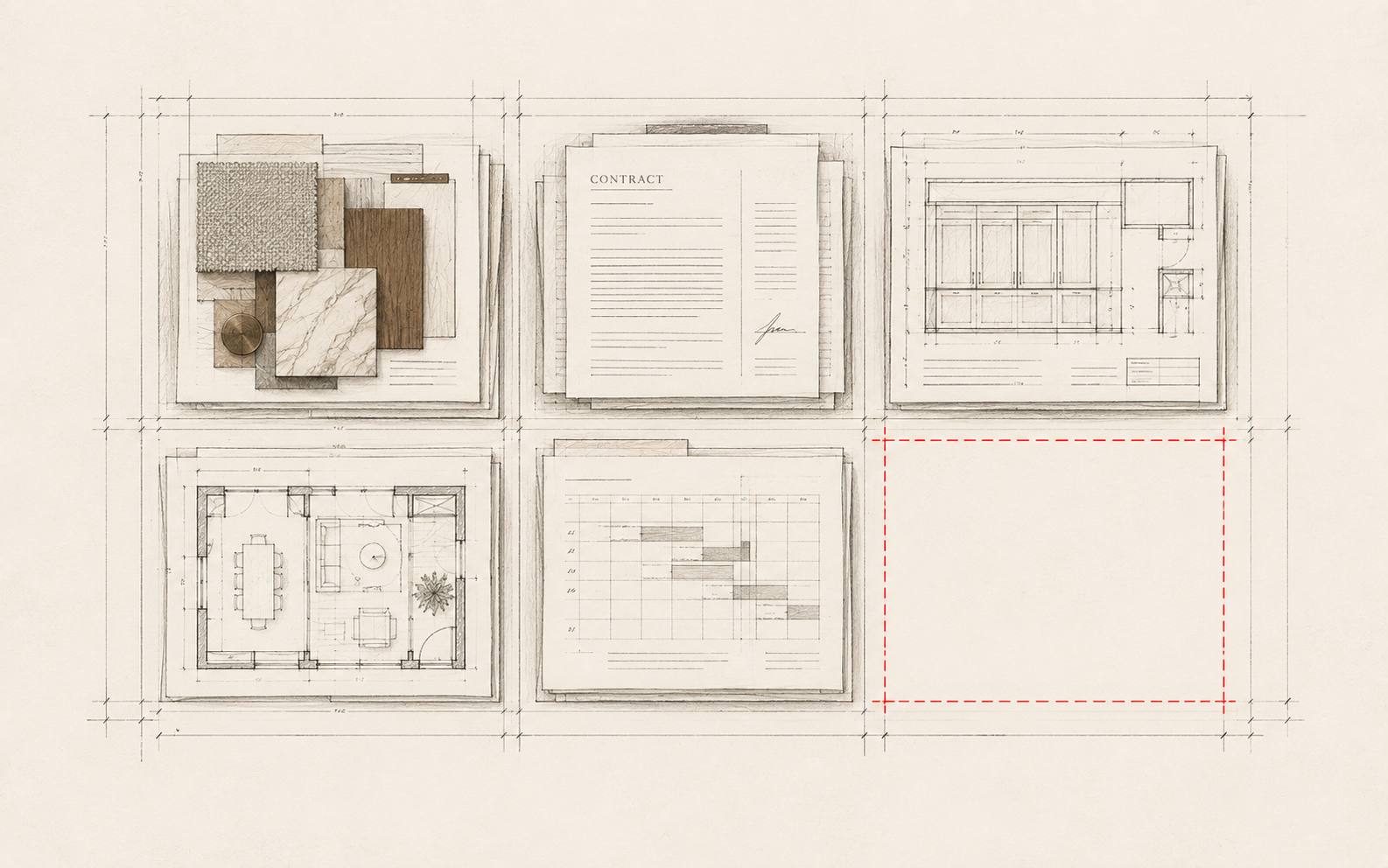
Six categories. Every one required. Missing any one carries risk into every project close.
Why Selective Documentation Creates More Risk Than No Documentation
A design firm with no documentation system knows what it has. Nothing. It negotiates from memory, absorbs disputes, and adapts.
A design firm with selective documentation has a different problem. It believes it has a record. When a dispute arrives, it discovers the category it needed is the one it skipped.
That discovery happens after the work is done. After the invoice is sent. After the client's memory of what was agreed has moved away from the designer's.
Selective documentation creates a false floor. The firm is not protected. It does not know it is unprotected. The gap is invisible until it is the only thing that matters.
The firms that close projects cleanly do not have more detailed records. They have complete records. Every category. Every project. No exceptions.
A missing category does not announce itself during the project. It announces itself during the dispute. By then, the cost of creating the record is higher than the cost of having made it at the time.
The Six Categories of Interior Design Project Documentation
1. Client Approvals and Selection Records
Client approvals and selection records capture every decision the client confirmed on finish selections, material choices, design direction, and specification sign-offs, with written confirmation from the client and the date received.
This is the category most design firms start with and most often capture incompletely. An email confirmation counts. A verbal yes does not. A text message counts if it is specific, dated, and retrievable. A showroom conversation that never had a written follow-up does not.
Every finish. Every fabric. Every specification the client saw and confirmed. Each one needs written confirmation specific enough to be unambiguous six months later when the invoice is questioned.
What makes this category hard is not the approvals themselves. It is the informal settings where design approvals happen: a walk-through, a sample review at the client's home, a showroom visit that ends with a verbal yes. The approval happens. The record does not.
For the full system for building this record and producing an audit trail that holds in a dispute: How to Track Client Approvals in Interior Design.
2. Scope Authorizations and Change Order Records
Scope authorizations and change order records capture every request to expand or alter the agreed project scope, including the written authorization, the fee impact, and the date the client approved moving forward before the work began.
This is where most project disputes originate. Not because scope changes happen. They happen on every project. Because the authorization was verbal. Or the fee conversation came after the work was done. Or the change order was issued and never returned with a signature.
A scope change without written authorization is an unrecoverable position when the client disputes the additional service fee. The record needs to exist before the work starts, not after.
The firms that recover their additional services fees consistently are not the ones with more aggressive billing practices. They are the ones with a record that existed before the dispute did.
The five-step scope change documentation system is here.
3. Vendor and Trade Commitments
Vendor and trade commitments capture every instruction, specification, and delivery agreement made with fabricators, contractors, trades, and suppliers, including who gave the instruction, what was specified, when it was confirmed, and what the agreed timeline was.
This is the category most firms treat as someone else's job. The contractor manages the trades. The vendor manages the order. The designer manages the design.
That division fails when a fabricator delivers the wrong dimension and both parties disagree on what was specified. Or a tile order arrives in the wrong quantity and nobody has a record of what was confirmed.
The designer's record of vendor and trade commitments is not a backup copy of the contractor's paperwork. It is an independent record of what the design team communicated and authorized. Those are different documents, and the difference matters in a dispute. A contractor's internal purchase order shows what was ordered. The designer's record shows what was specified and confirmed before ordering. When those records conflict, the designer's record is the one that establishes what the design intent actually was.
4. Design Decisions and Specification History
Design decisions and specification history capture the reasoning behind significant design choices, including what alternatives were considered, what drove the selection, and which version of the specification was current at each project phase.
This category looks optional until a project is reopened, handed off, or disputed.
A specification history answers questions the other five categories cannot: Why was this millwork profile selected over the original? When did the ceiling height change and what drove that decision? What was the basis for the tile pattern direction? These questions have answers. If the answers are not in the record, they live in someone's memory.
Memory is not a retrievable system. It is also not a defensible one. The design decision record is.
For firms with any team members, this category carries an additional function: onboarding. A designer brought into an active project mid-stream has context if the specification history is documented. Without it, she has to reconstruct the reasoning from conversations with the principal, at a cost to both of them.
5. Timeline and Milestone Sign-offs
Timeline and milestone sign-offs capture every schedule commitment made during the project, including the dates both parties agreed to, any revisions to those dates, and the written acknowledgment that a phase was completed and the next could begin.
Timeline disputes follow a consistent pattern. The designer believes the project is on schedule because the work is proceeding. The client believes the project is late because a date mentioned in conversation was never in the written record, or was revised without written acknowledgment.
The milestone record closes that gap. It documents what was agreed, when, and what both parties confirmed at each phase transition. It turns a billing conversation into a confirmation rather than a dispute about what was originally promised.
Any revision to an agreed timeline needs the same treatment as the original commitment: written, acknowledged, dated.
6. Project Communication and Instruction Records
Project communication and instruction records capture the material instructions, directives, and decisions communicated to any project party during the project, including who gave the instruction, who received it, when it was given, and what action it authorized.
This category catches what every other category misses.
The contractor question answered verbally on a Thursday site visit. The design direction sent in a text message thread on one person's phone. The specification change communicated to a vendor on a call that nobody documented. Every project generates a volume of these communications. Most are routine. A small number are the ones a dispute hinges on.
The record needs to exist regardless. The routine communications are easy to verify if they are in the record. They are expensive to reconstruct if they are not.
When to Document Each Category (Timing Rules by Project Phase)
The rule is: document before the next action happens. Not at project close. Not in a batch at month end. Before the work starts on whatever follows.
Concept and programming phase: Category 1 begins here. Every directional decision the client confirms, from concept sign-offs to program confirmations to mood direction approvals, enters the client approval record now. Category 4 begins with the rationale behind concept direction choices.
Design development phase: Category 2 becomes critical. This is the phase where scope changes most often originate. Every request to add or alter the agreed scope needs written authorization before work on the change begins. Category 4 grows with each design development decision, capturing what changed and why.
Construction documents phase: Category 3 starts in earnest. Every specification going to a fabricator or contractor needs a record of what was communicated and confirmed. Category 5 should capture the phase completion and the agreed timeline for the next phase, with acknowledgment from both parties.
Procurement and installation phase: Category 3 carries the highest risk here. Delivery errors, substitution disputes, and installation conflicts originate in this phase. The record of what was specified, confirmed, and authorized needs to be complete before installation begins, not reconstructed after a delivery arrives wrong. Category 6 is active and high-volume throughout.
Project close: Category 6 is the cleanup pass. Any instruction or directive that affected the project but was not previously captured needs to enter the record before the project closes. This is also the moment to confirm that all six categories are complete, not just the ones that felt important during the project.
Every day between an event and the record is a day the facts are harder to verify accurately. The timing rule applies to all six.
What Happens When a Category Is Missing
Each missing category has its own failure mode. The other five categories being complete does not protect against it.
Missing client approvals: The invoice is disputed. The client does not remember approving the finish that was specified. The firm has no written record. The resolution costs time, the client relationship, or the fee. Often more than one of the three.
Missing scope authorizations: The additional services fee is disputed. The client recalls a different version of the scope conversation. Without a written authorization that predates the work, the firm cannot establish what was agreed. The additional fee is difficult or impossible to recover.
Missing vendor and trade commitments: A fabrication error goes to dispute. Both parties agree the work was wrong. They disagree on what was specified. Without the designer's independent record of what was communicated and authorized, there is no way to establish what the design intent actually was. Rework costs are absorbed by whoever lacks the record.
Missing design decision history: A project is reopened, handed off to a new team member, or disputed by a client who claims a specification was never discussed. The reasoning behind the design choice cannot be reconstructed. The principal has to explain decisions made two years ago from memory, against a client who has her own memory of the same conversation.
Missing timeline sign-offs: The client disputes whether a delivery delay was on the firm or the vendor. The schedule conversation was verbal. The firm cannot prove what was agreed or when the timeline was revised. The delay becomes the firm's problem regardless of where it originated.
Missing communication records: An instruction given verbally to a contractor is executed incorrectly. The contractor says they followed what they were told. The designer says what she communicated was different. Neither party has a record. The rework dispute begins. The party without documentation pays.
None of these failures require bad intentions on anyone's part. They require only the absence of a record. The record is the only thing that settles them without cost.
Tools Interior Designers Use to Build a Complete Project Record
The goal is not the tool. It is all six categories being complete, current, and retrievable throughout the project.
Shared document systems: A central project folder organized by category can cover all six with consistent discipline. The limit is that every entry requires a deliberate manual step. The record is only as current as the last time someone updated it, and on a busy project that can be weeks behind.
Project management platforms: Strong for timeline and milestone tracking. Not purpose-built for approval records, scope authorizations, or specification history. These categories typically require separate manual entries outside the platform's core function, which means they are often the first to fall off when the project is moving fast.
Contract and change order tools: Handle scope authorization records well. Do not typically capture client selection approvals, vendor commitments, or design decision history without additional manual effort alongside them.
Email and communication archives: Category 6 often lives here by default. Technically present. Rarely organized or retrievable quickly. An approval buried in reply 14 of an email thread exists, but it is not a system anyone can search under pressure.
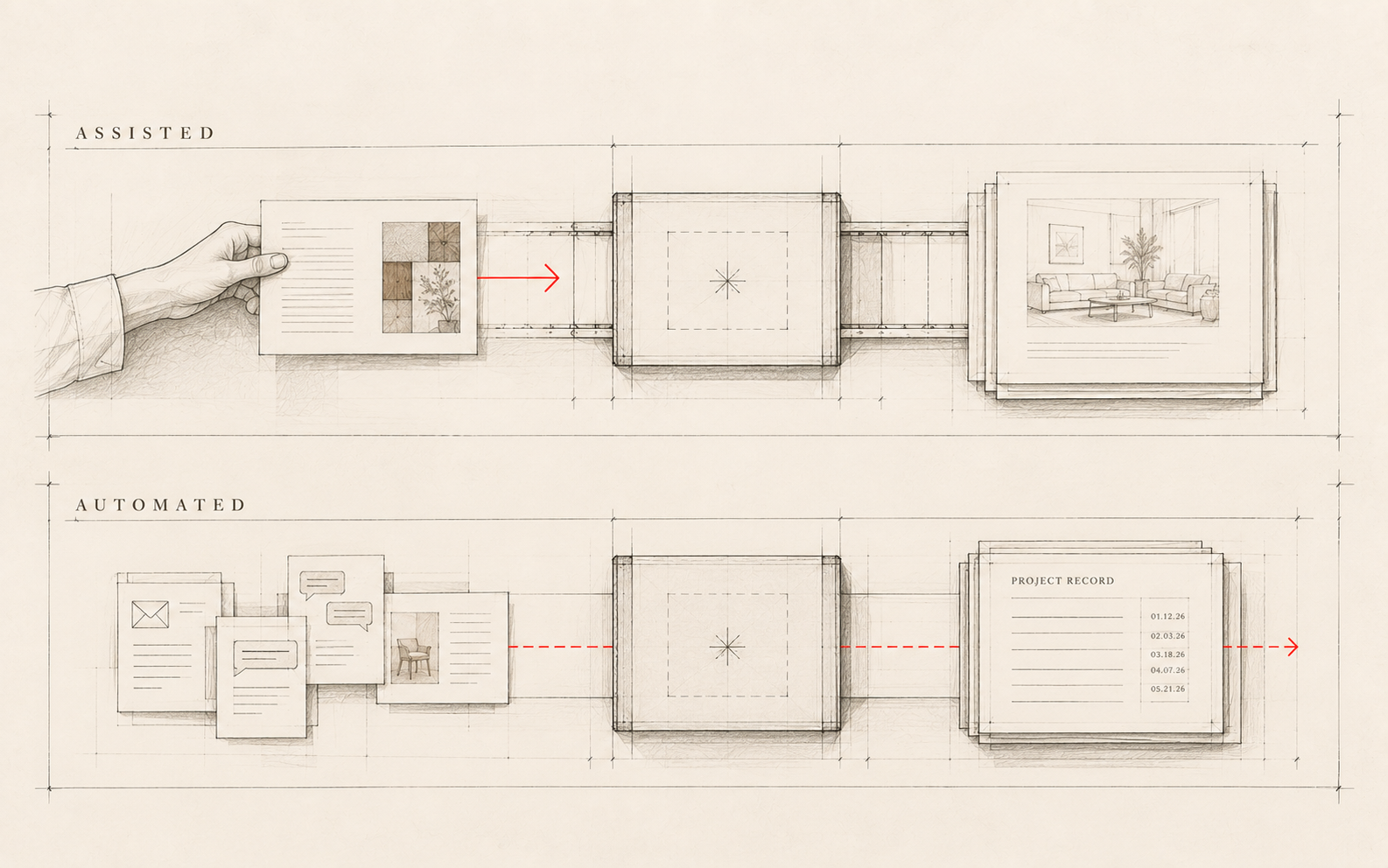
Archen™: Archen™ reads your existing project communications, including email threads, call recaps, approval confirmations, and vendor correspondence, and builds the record across all six categories automatically, without requiring a manual logging step for each category separately. The record builds as the project moves. When a dispute arrives, the record is retrievable because it was captured from the communications that already happened, not assembled afterward.
The record that protects a project does not require a perfect system. It requires a complete one.
Source note: The 60% fewer late-stage revisions figure is from Architectural Record; the 40% fewer scope disputes figure is from PSMJ Resources. Both are secondary citations, sourced from the Monograph blog post "Proven Strategies to Manage Project Scope Creep." Original publication dates of the underlying statistics are unknown. These are A&E sector findings; no interior-design-specific equivalents are known to have been published in peer-reviewed literature. Source tier: T2.